
If you have a change of heart
You can finish what you start
What’s lost you shall regain
Down on Thimbleberry Lane
Travel north on Highway 101 along the Oregon coast and just outside of Port Orford you’ll pass a small street sign for Thimbleberry Lane. Don’t blink or you’ll miss it.
On a clear summer day when the marine layer is stalled off the coast this part of Oregon is a sun-splashed dream, the quality of light is vaguely psychedelic and the rainy weather is on hold. Down in California hordes of people are all duking it out for the few good camping spots, semi trucks, leviathans of the American highway system, roar endlessly up and down Highway 5. Here on the Oregon coast it’s just cars and a wide assortment of vans, RVs and campers, all of us on a leisurely crawl and in no hurry to get anywhere. It’s summertime in Oregon: they pump your gas for you and the price on an item is the price you pay because there’s no sales tax up here.
The access points to the dazzling coastal scenery are many, it’s nearly impossible to travel more than a few miles without an opportunity to pull over and take in the views. You say you’re up for some camping? Well the Oregon state parks are exquisite. Campsites are large and tidy with new picnic tables and fire pits that are clean and free of “white trash” items like aluminum cans and broken bottles. The bathrooms and showers are spotless, hiking trails and beach access points are well marked, camp hosts and park rangers are friendly, helpful and well informed. The world class nature of these parks is evidence that the state of Oregon takes great pride in (and spends enough money) to maintain them that way.
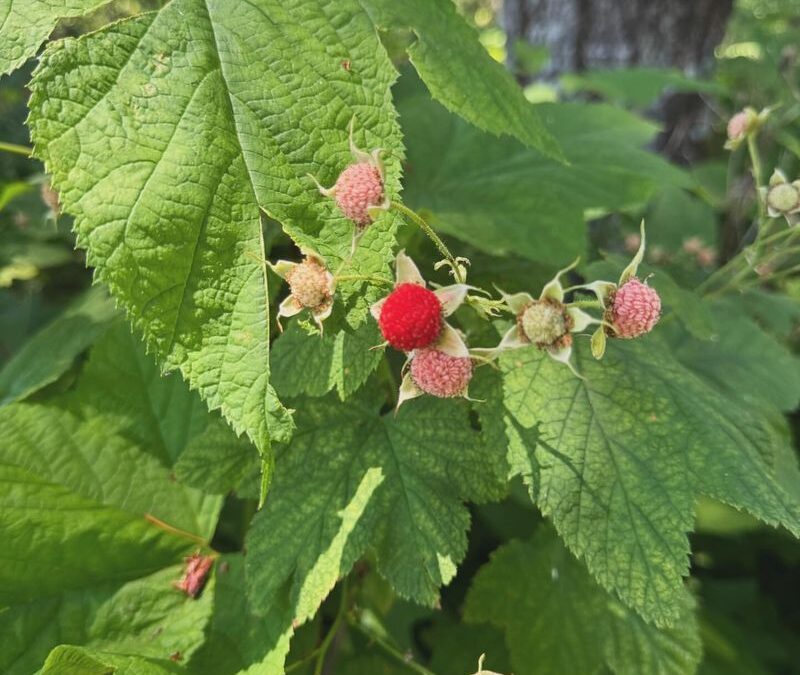
But back to Thimbleberry Lane. This eponymously named street celebrates one of the true gems of the coastal forest. Thimbleberries are indeed shaped like the tip of a thimble, they ripen atop slender branches surrounded by the broad, hand-sized leaves of the bush. These plants thrive in the shade of the forest, usually along the riparian habitat of a creek. The ephemeral nature pf this delicate, crimson fruit is one of its most alluring qualities. Compared to prolific fruiting plants like raspberries and blackberries, a thimbleberry bush produces relatively few berries. You can’t buy them in a store either so if you’re out hiking and spot a fruiting bush you better get ‘em before the birds and bears do. And the taste? A little tart, a little sweet and a lot of heaven. Their deep color stains the fingertips and is evidence of your find long after the taste has faded from your tongue. When I eat a thimbleberry I deeply savor the taste, these berries are fragile and nearly fall apart in my fingertips. I don’t really chew one as much as crush it with my tongue and let the berry dissolve in my mouth. Unlike blackberries and raspberries there are no seeds to get stuck between my teeth. And by the way, I never eat all of the berries on a bush, I like to pay it forward and leave a few for the next observant hiker to enjoy.
Wait, I was talking about Thimbleberry Lane, right? To be honest we sped right by it, I didn’t blink and was a passenger at the time so I saw the sign. My notebook was handy, I pulled it out and wrote the poem that begins this essay. So… I’m imagining Thimbleberry Lane as it winds east from the coast, becoming a narrow one-lane path when it enters the forest, eventually terminating in a dead-end deep within the trees. You can either turn around here or leave your car and explore. There’s a faint trail so you follow it. The canopy grows denser, dappled sunlight dances upon the forest floor. The silence is hypnotic. It’s late afternoon and you hear the distant whoo-whoo of a Great Horned Owl as it prepared for its nightly hunting foray. The faint chip-chip of a tiny winter wren gives its location away in the thick understory. The heady scent of the forest makes your head spin. When you hear the bubbling song of a hidden creek that’s the moment you spot the thimbleberries. Dive in and enjoy, just remember to save a few.
Louie, you are one very sweet man!
Wow, what I would give to find a hummingbird nest! We’ve got a number of these birdies but what with…
❤️❤️❤️❤️❤️❤️❤️❤️❤️❤️
Psst. Hey Notebook…. Shhh! Don’t tell him I’m talking to you. Listen, maybe suggest to Louie to, y’know. Change up…
Very Clever! ❤️