
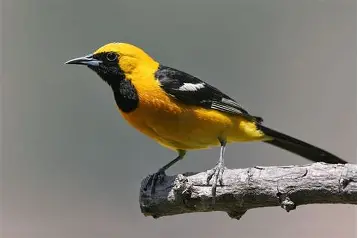
Spring arrived in my neighborhood this morning in the form of a brilliant orange jewel. Perched at the very top of our neighbor’s towering coast redwood tree, the Hooded Oriole seemed to glow from within as it basked in the rays of the rising sun. My calendar told me that the vernal equinox was five days ago but I never feel like spring has really arrived until the Hooded Oriole has.
This is the time of year for the “songbird shift change”. The yellow-rumped warblers, and golden and white-crowned sparrows, ubiquitous here throughout the fall and winter, have moved on to their summer digs to be replaced by the spring crew. Most notable among them is the Hooded Oriole. The deep orange hue of its body is offset by a jet black throat patch and black wings with white bars which makes this bird hard to miss. Our oriole gives California poppies and chrysanthemums a run for their money in the gorgeous shade of orange department.
There’s something about the Hooded Oriole that’s really captured my imagination. When mid-March rolls around I begin to listen and to look out for it. I almost always hear it before I first see it. Its call is distinctive and my ears are keyed into the sound. Today was extra cool, what an unexpected delight it was to see the first oriole of the season greeting the morning sun from atop the tallest tree in our neighborhood.
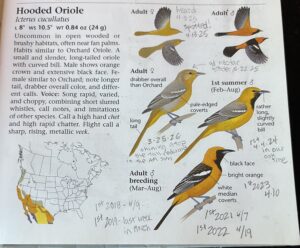
I record my initial observations of the oriole in my trusty field guide.
Hooded Orioles prefer to build their nests in fan palm trees. Luckily for us our neighbors have one in their backyard. How these birds manage to find their way back to the same tree year after year is a mystery that I hope is never fully solved. Some things are just not meant to be known. Throughout history people have puzzled over animal migration. Where do they go and how do they find their way back? It was once believed that birds hibernated in winter! Hooded Orioles spend their winters in Central America. It’s a long way from the rain forests of Costa Rica to my backyard but these spunky little songbirds make the journey every year.
All throughout spring and summer I watch the orioles come and go from their home in the fan palm. One will often settle for short periods in the cypress trees that border our yard so we get an up close and personal view without the aid of binoculars. A few years ago I learned that the orioles like to drink from hummingbird feeders so I removed a couple of the faux flowers off of one of our feeders. Every so often an oriole will perch there and dip its long, pointed bill in for a sip. When their young are hatched I’ll occasionally observe the fledglings fly clumsily around the yard. Usually though, I just catch a flash of orange as a bird wizzes by. I enjoy every day that the orioles are here, the fleeting nature of their stay makes it that much more special to me. Then just like that, one day they’re gone. It’s a little bittersweet when I notice that they’ve moved on but I know that come springtime they’ll be back.
Hope seems to be in short supply nowadays but when I first see the Hooded Oriole my heart is filled with it. I have to remind myself that the follies of the human race and the evil machinations of our “leaders” are temporary. The spring arrival of the orioles to our part of the world has been going on for a very long time and they’ll keep arriving long after this current shit show has played its final act. I take great comfort in the predictability of this timeless and mysterious event.
I think I’ll just let the mystery be
Iris Dement
Wonderful. A good feeling in these dark times.
Thanks for weighing in Mrs. C.
The follies of the human race are temporary-love this!
I lived in Sebastopol for 20 years. We had palm trees in our backyard, but an Oriole couple decided to make their yearly sock nest in the adjacent Japanese Maple. From our high deck we had a wonderful horizontal view every Spring. Now I live in North Carolina and have traded the Orioles for the Cardinals.