
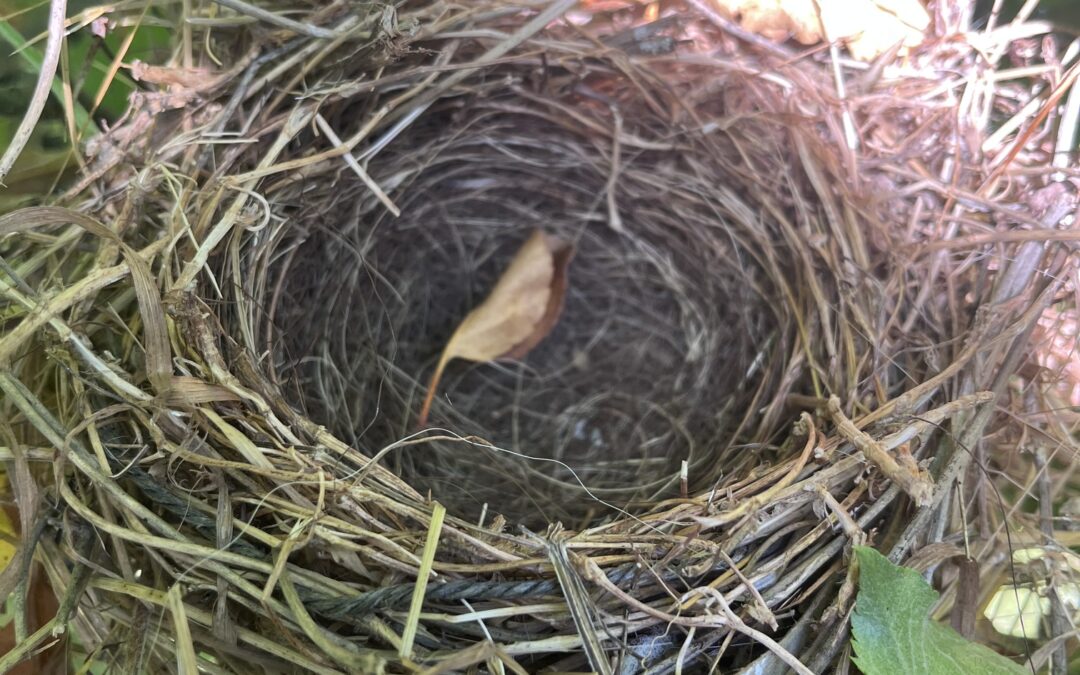
All throughout spring and early summer the birds in our backyard have been busy. The lesser goldfinch population is larger than it’s ever been and they’ve all been jockeying for position at the feeders. A pair of house finches have been a constant presence. The male’s flame-red crown and breast stand in stark contrast to its mate’s drab coloring. A pair of noisy scrub jays squawked at and dive bombed our cat Ella, letting her know in no uncertain terms that her presence was not welcome. The hooded orioles set up shop in their usual spot high atop our neighbor’s fan palm. The chip, chip of our resident California towhees announced their daily presence. All of these birds were busy doing what birds do in springtime.
The places where birds chose to build their nests are secretive and mysterious. All spring long I observed birds fly about with bits of nesting material in their bills, disappearing into the trees and thick shrubs that surround our yard. A bird’s nests is a miracle of engineering. It’s not often that I discover one but when I do it’s a rare opportunity to see up close the ingenuity of its construction. In late June we returned from a two week camping trip to find that our towhees had built a nest in the apple tree. This nest was perfectly camouflaged, I only discovered it when I saw a bird fly into the foliage. I did grab a peek once or twice but mostly kept my distance while mom sat on the nest. I’ve been lucky in past years to stumble upon a couple of hummingbird nests in our yard. The eggs are the size of pinto beans, the nests not much larger. I read that hummingbirds use bits of spider’s webs to construct their nests. How cool is that? The summer stretched on and when we returned from another two week trip the bird population in our yard had grow considerably.
Right now juvenile birds abound in our yard and I’ve been loving watching these young birds find their way in the world. These young creatures are much like their human counterparts, they’re busy discovering new things, excited about everything and testing their boundaries. The other morning a recently fledged house finch was just sitting atop our barbecue a few feet from me, oblivious to its surroundings. It had yet to develop a fear of humans but will soon learn to keep a safe distance from its most dangerous predator.
These young birds all have remnants of down on their bodies and some can be quite comical looking. The house finches have bits of downy feathers sticking out from their crowns and bodies at weird angles much like the cowlick on a teenage boy. The former egg in the towhee nest has been busy exploring its surroundings too. With the help of its parents it’s learning how to use the seed feeder. Juvenile Jay is the big boy on the block and acting like it too, chasing smaller birds from the feeders and squawking up a storm.
The redwood sapling we planted ten years ago is now over 20 feet tall and a favorite perch for birds of all types. This morning a young hooded oriole sat in its lower branches and I stood observing it no more than six feet away. It appeared indifferent to my presence until mom came by and whisked it away. The message: Stay away from humans!
My neighbor texted me a few mornings ago and asked if I wanted to see a fledgling hummingbird she’d found on the ground. When I arrived she was holding it inside another songbird nest she had collected last summer. The bird’s body was maybe an inch long. I could see its tiny heart beating. When I ran my finger down its body the iridescence of its feathers came to life. It felt like I was touching a whisper.
With all of these young birds about I can barely keep the feeders filled. I’m spending a small fortune on bird seed but it’s a small price to pay to help nurture the next generation of songbirds. Our backyard has begun to resemble a playground full of first graders at recess, it gives me hope for the future and fills my heart with joy. Life finds a way, life goes on.
It’s a messed up world but I love it anyway
Greg Brown
❤️❤️❤️❤️❤️❤️❤️❤️❤️❤️
Wow, what I would give to find a hummingbird nest! We’ve got a number of these birdies but what with our neighbors with their 6 or 7 very tall conifers, and only one tree in our backyard (the peach tree), we’ve visitors but no tenants.
You can certainly watch the various birdie parents flitting in and out of those trees during the day (and similarly all the bats at night) though.
We don’t put out feeders in the spring and summer due to all the other available food in our garden and the gardens of our neighbors, but we do grow a lot of native flowers and pretty much let the plants take over everything, making a lot of seeds (favorites of the local songbirds are lupine and bachelor button seeds). Also we’ve pruned the peach tree to have a lower “crown” (our peaches) and an upper crown (peaches for birds, bees, wasps, and the occasional squirrel).
Watching various critters in the garden is one of my favorite ways to unwind from the “messed up” world.